
Product case study · B2B sales & distribution
Sales Intelligence & Account Health for a US Distributor
Salt built an analytics platform for a US promotional products distributor to bring customer account health, sales performance, and reorder patterns into one workspace.
Discuss a similar projectThe starting point
The business problem.
Sales information was spread across spreadsheets and systems. Reps needed to understand which accounts required attention, while managers needed a consistent view of territory performance.
Salt’s contribution
What the work covered.
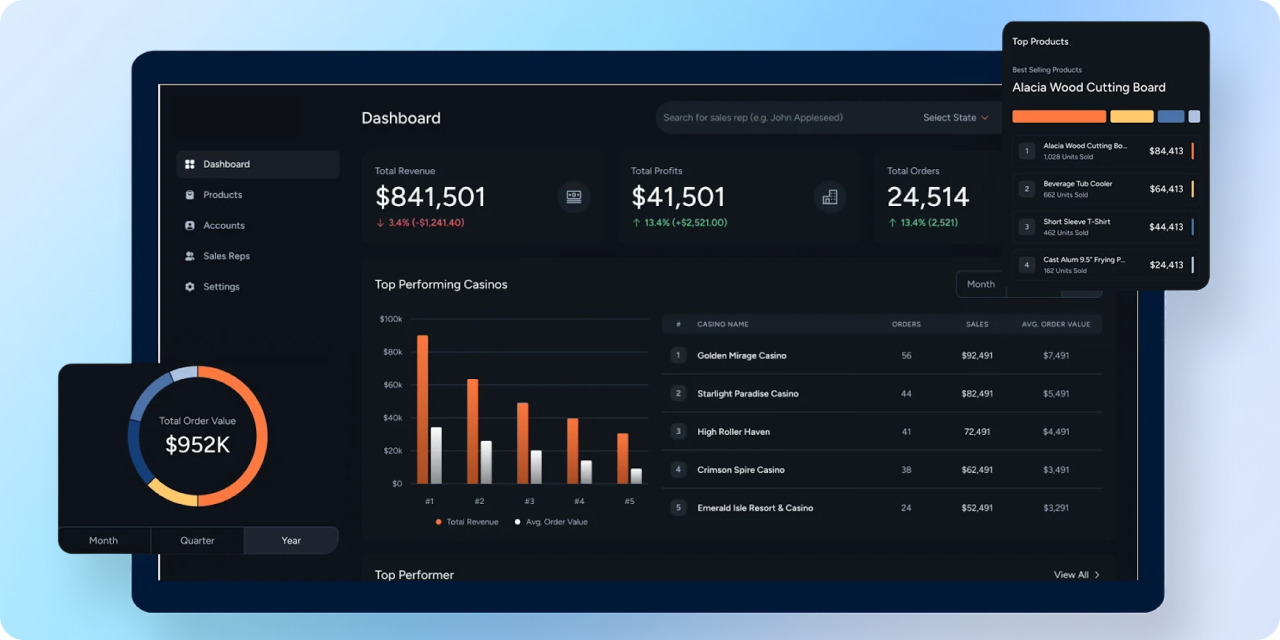
The platform brings together order history, account segmentation, geographic search, product analytics, and predicted reorder windows. Account scoring uses historical buying signals to help reps prioritize outreach.
Inside the delivery
The work in practical terms.
Explore the scope and implementation details relevant to a similar engagement.
Project detail
How the work
comes together.
Who the platform supports
The distributor serves multi-location hospitality and casino accounts. Sales representatives need to see individual account activity, managers need territory visibility, and leadership needs a broader performance view. The application connects those perspectives through shared sales and customer information rather than separate spreadsheet workflows.
From account history to follow-up priorities
Account views bring together buying history, the latest order, health categories, and a predicted reorder window. Segments include loyal, at-risk, neutral, disengaging, and churned accounts. Scoring uses recency, frequency, value, trends, and product mix to give representatives context for investigation and follow-up. These signals support judgment about the customer relationship; they do not guarantee a future order.
Territory and product exploration
Map-based search lets users filter accounts using sales, order volume, order amount, and representative information. A linked list and map help teams move from a regional view to the underlying account. Nearby-account information supports planning around geography as well as account status.
Product views expose category trends over monthly, quarterly, and yearly periods. Executive summaries cover revenue, profit, and orders with period comparisons, alongside leading accounts, representatives, and products. Together, these views give users several ways to investigate a change instead of stopping at a single headline KPI.
How the application connects the data
The implementation combines a React and Next.js interface, TypeScript, Node.js APIs with role-based access, PostgreSQL aggregates, Mapbox, and scheduled scoring refreshes. Aggregated data supports repeated dashboard queries, while the account detail provides context behind the summaries.
The architectural lesson for a similar project is to plan both the dashboard and the data preparation behind it. Metric definitions, account matching, update frequency, permissions, and handling incomplete records shape whether users can trust the final view.
Delivered capability
What the team can do.
Sales teams can review account activity, spot at-risk customers, explore regional performance, and plan outreach from a connected workspace.
Technology used
The implementation stack.
React / Next.js, TypeScript, Node.js, PostgreSQL, Mapbox
Explore ways to work with SaltApply the experience
Explore relevant expertise.
Build on relevant experience
Working through a similar challenge?
Tell us about your users, existing systems, and the change you need. We’ll help define an appropriate scope for your project.