
Product case study · Healthcare & behavioral health
AI-Assisted Intake Documentation for US Behavioral Health
Salt built a web application for a healthcare technology team serving addiction treatment facilities in the US. It connects recorded intake assessments, transcripts, and structured documentation for clinician review.
Discuss a similar projectThe starting point
The business problem.
Manual intake processes created inconsistent notes, repetitive documentation work, and fragmented assessment records. The team needed a repeatable workflow across facilities.
Salt’s contribution
What the work covered.
Patients complete guided assessments. The system captures responses, produces timestamped transcripts, and generates structured summaries. Clinicians review the material, while administrators manage facilities, providers, and summary templates.
Application workflow
From assessment to clinician review
- 01
Capture
Patients complete guided, recorded assessments.
- 02
Transcribe
Timestamped transcripts connect text with the captured recording.
- 03
Structure
AI produces draft documentation using configured templates.
- 04
Review
Clinicians examine the documentation with the underlying material.
Implementation detail
How responsibilities and technology fit together.
| Area | Implementation or responsibility | Documented scope |
|---|---|---|
| Assessment capture | Patient workflow | Guided questions, recorded responses, progress, and assessment status. |
| Documentation | Transcripts and structured summaries | Timestamped text and generated draft documentation, with recordings available for review. |
| Configuration | Administrator workflow | Facilities, providers, active/inactive states, and configurable summary templates. |
| Technology | Published application stack | React / Next.js, TypeScript, PostgreSQL, Amazon Bedrock, API and media-processing services. |
Inside the delivery
The work in practical terms.
Explore the scope and implementation details relevant to a similar engagement.
Project detail
How the work
comes together.
The users and workflow
The application supports a healthcare technology team serving US addiction treatment facilities. Patients complete guided intake assessments, clinicians review the resulting material, and administrators manage the facilities, providers, and documentation configuration. Each role has different tasks within the same assessment lifecycle.
Capturing and finding assessments
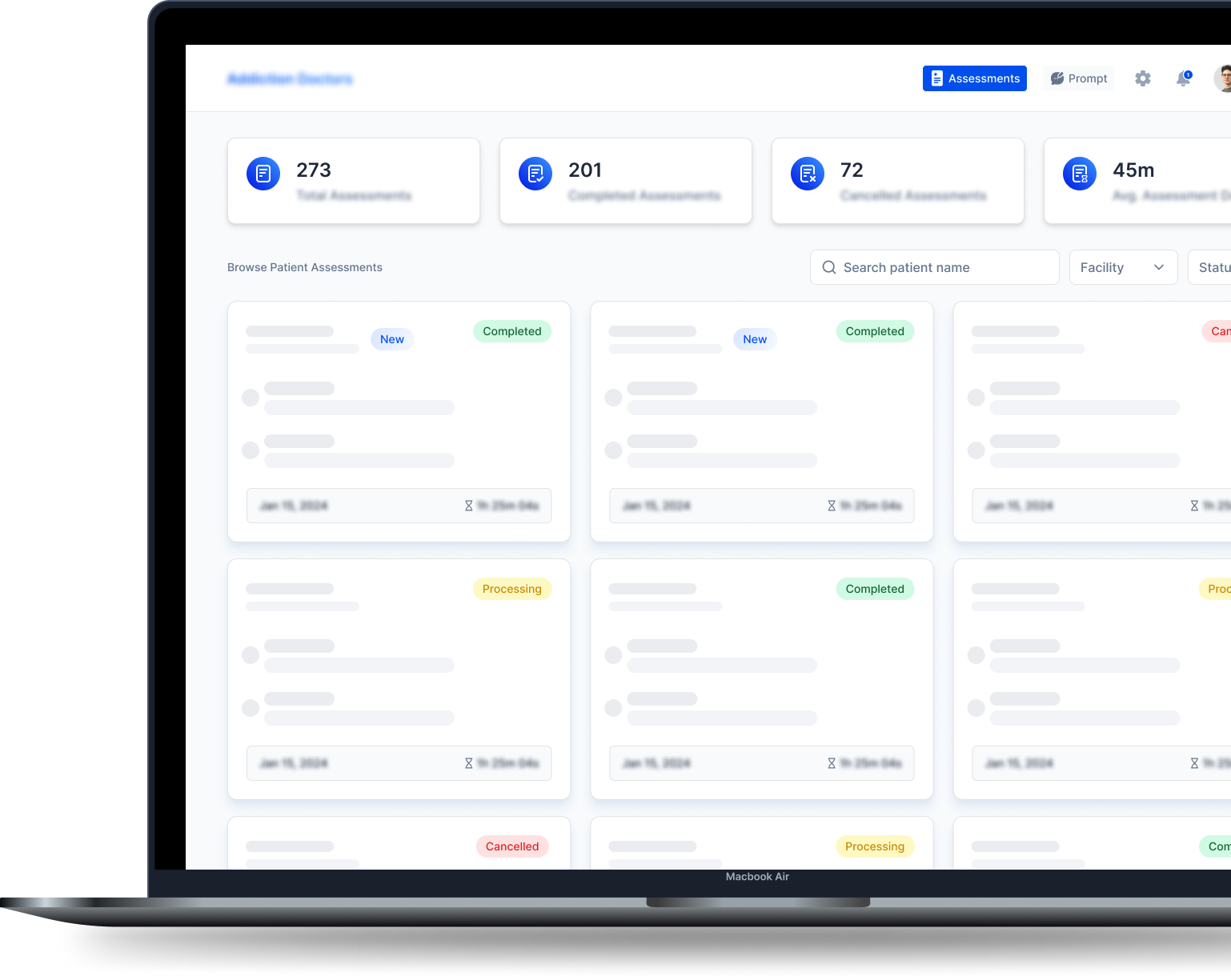
Video-led questions guide the assessment, capture responses, and show progress. Assessment records move through statuses including New, Processing, Completed, and Cancelled. Search and filters by patient, facility, or status help staff find the relevant record without relying on separate files and messages.
Recording playback preserves access to the captured material. Timestamped transcripts help reviewers connect text with the relevant part of a recording. These features support review and traceability within the workflow rather than presenting a generated summary as the only record.
Where AI fits
The system produces structured summaries from assessment information for clinician review. Administrators configure summary sections and templates through prompt management. Amazon Bedrock is part of the documented stack alongside the application, database, and media-processing services. Generated documentation is provided with recording and transcript context so a clinician can check the underlying information. This is documentation assistance, not autonomous diagnosis or treatment selection.
Administration and access
Facility and provider administration includes active and inactive states, while role-based access supports different user responsibilities. Configurable templates let the organization adapt documentation structure. The published scope describes application controls; deployment, data handling, contractual responsibilities, and regulatory requirements must be assessed for each implementation.
Delivered capability
What the team can do.
The application gives care teams a consistent way to capture, retrieve, and review assessment information. AI supports documentation; clinicians remain responsible for review and decisions.
Technology used
The implementation stack.
React / Next.js, TypeScript, PostgreSQL, Amazon Bedrock; API and media processing services
Explore ways to work with SaltApply the experience
Explore relevant expertise.
For your project
Considering AI-assisted documentation?
Use these questions to frame your scope. These are planning considerations for a new engagement, not additional features claimed for this project.
- What information must the assessment capture, and who reviews the output?
- Which templates, access rules, and source records must the application support?
- How will your team evaluate omissions, incorrect summaries, and review effort?
Build on relevant experience
Working through a similar challenge?
Tell us about your users, existing systems, and the change you need. We’ll help define an appropriate scope for your project.