
Last quarter, one of our senior engineers shipped a feature in 3 days that our internal estimates pegged at 2 weeks. When we dug into what happened, the answer wasn't overtime or cutting corners—it was a fundamentally different way of working. He'd integrated GitHub Copilot so deeply into his workflow that the tool had become less of an assistant and more of a cognitive extension.
This wasn't an outlier. Across our 100+ engineers at Salt Technologies, we've tracked a consistent 30-40% reduction in time-to-first-commit for routine coding tasks since adopting AI copilots across our Managed Pods in early 2024. But here's what the breathless LinkedIn posts won't tell you: that same tooling introduced new categories of bugs we'd never seen before, required us to completely rethink code review processes, and forced uncomfortable conversations about what "senior" even means when a junior developer with strong prompting skills can out-produce a veteran who refuses to adapt.
AI copilots aren't making software development easier. They're making it different. And the engineering leaders who understand that distinction are the ones capturing real competitive advantage.
What Exactly Is an AI Copilot in Software Development?
Before we dive deeper, let's establish a clear definition—because "AI copilot" has become one of those terms that means everything and nothing.
An AI copilot in software development is a machine learning system that assists developers in real-time by generating, completing, or suggesting code based on natural language prompts and existing code context. Unlike traditional autocomplete or snippet libraries, AI copilots use large language models trained on billions of lines of code to understand intent, not just syntax.
The Technical Foundation
Modern AI copilots rely on transformer-based large language models (LLMs) fine-tuned specifically for code generation. GitHub Copilot, for instance, is powered by OpenAI's Codex model, while Amazon CodeWhisperer uses Amazon's proprietary models trained on internal and public code repositories.
These tools work by analyzing several inputs simultaneously:
- The current file you're editing and its language/framework context
- Open files in your IDE that might contain relevant patterns
- Your natural language comments describing what you want to accomplish
- The broader codebase structure (in more advanced implementations)
The output ranges from single-line completions to entire functions, test suites, or boilerplate implementations.
What AI Copilots Are Not
Clarity on limitations matters as much as capabilities:
- They are not autonomous agents (yet). AI copilots don't make architectural decisions, manage deployments, or understand your business requirements without explicit guidance.
- They are not search engines. While they can reference patterns from training data, they don't have access to live documentation or your company's internal wikis unless specifically integrated.
- They are not replacements for code review. In fact, they make rigorous review more important, not less.
The Current State of AI-Assisted Development: 2026 Landscape
The AI copilot market has matured significantly since GitHub Copilot's public launch in 2022. What was once a novelty is now a standard line item in enterprise software budgets.
Market Adoption Numbers
According to GitHub's 2025 State of the Octoverse report, over 1.8 million developers actively use GitHub Copilot, with enterprise adoption growing 142% year-over-year. Stack Overflow's 2025 Developer Survey found that 76% of professional developers have used an AI coding assistant, up from 44% in 2023.
The question is no longer whether to adopt AI copilots, but how to adopt them effectively.
The Major Players Compared
Here's how the leading AI copilot tools stack up for enterprise use as of early 2026:
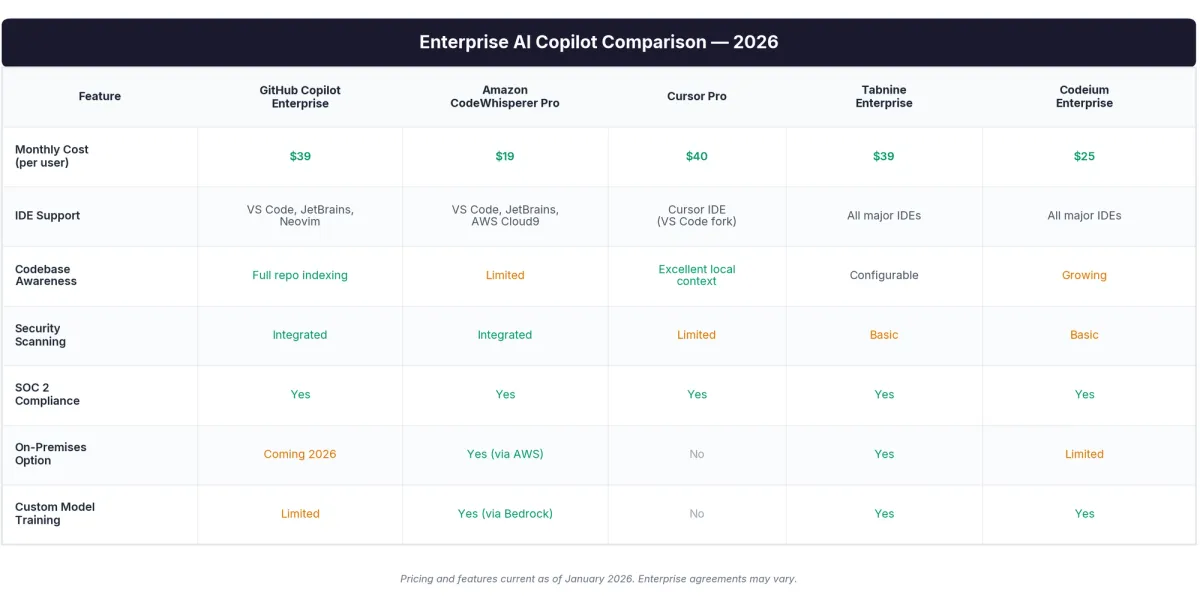
At Salt Technologies, we've standardized on GitHub Copilot Enterprise for most of our Managed Pods, primarily due to its superior codebase indexing capabilities and tight GitHub integration. However, we've deployed CodeWhisperer for clients with existing AWS infrastructure and compliance requirements that favor keeping tooling within a single vendor ecosystem.
Real Productivity Gains: What the Data Actually Shows
Let's talk numbers—but honestly, because the productivity claims around AI copilots range from conservative to fantastical depending on who's selling what.
What We've Measured Internally
Over 18 months of tracked usage across 47 projects at Salt Technologies, we've documented these patterns:
Tasks where AI copilots deliver substantial acceleration (40-60% time reduction):
- Writing unit tests for existing functions
- Implementing standard CRUD operations
- Creating boilerplate code (API endpoints, data models, configuration files)
- Converting code between similar languages or frameworks
- Writing documentation and inline comments
- Regex pattern creation and validation
Tasks where acceleration is modest (10-25% time reduction):
- Debugging complex issues
- Refactoring legacy code
- Performance optimization
- Implementing business logic unique to the domain
Tasks where AI copilots provide minimal benefit or actively hinder:
- System architecture decisions
- Security-sensitive implementations
- Novel algorithm development
- Integration with poorly documented third-party systems
The Hidden Productivity Tax
Here's what most vendor case studies omit: AI copilots introduce a review overhead that partially offsets raw speed gains.
When a developer writes code manually, they're simultaneously reviewing their own work—catching typos, reconsidering logic, noticing edge cases. When an AI generates 50 lines of code in seconds, that review burden doesn't disappear; it shifts entirely to after generation.
We've found that code review time increases by approximately 15-20% when reviewing AI-assisted pull requests, primarily because:
- Reviewers can't assume the author understands every line
- AI-generated code often includes subtle incorrectness that looks plausible
- Consistency with codebase conventions requires closer inspection
The net productivity gain remains positive, but it's not as dramatic as the "10x developer" headlines suggest.
The Quality Question: Are AI Copilots Making Code Better or Worse?
This is the conversation engineering leaders should be having but often aren't.
The Case for Better Code
AI copilots genuinely improve code quality in several ways:
Consistency at scale. When your copilot has ingested your codebase's patterns, it suggests code that stylistically matches existing conventions. For teams struggling with inconsistent coding styles, this acts as a soft enforcement mechanism.
Reduced "clever" code. Counterintuitively, AI suggestions tend toward readable, straightforward implementations rather than clever one-liners. The models optimize for patterns that appear frequently in training data, which skews toward maintainable solutions.
Better test coverage. The biggest quality win we've seen is in testing. Developers who previously wrote minimal tests now generate comprehensive test suites because the marginal effort dropped dramatically. Our test coverage across AI-assisted projects averages 78%, compared to 61% on pre-copilot projects.
The Case for Worse Code
Cargo cult programming at scale. When developers accept suggestions they don't fully understand, the codebase accumulates technical debt invisibly. The code works, but nobody knows why—and nobody can safely modify it later.
Security vulnerabilities. Research from Stanford published in late 2024 found that developers using AI assistants were more likely to introduce security vulnerabilities than those coding manually. The copilot suggests insecure patterns, and developers—especially juniors—accept them without scrutiny.
Homogenization of solutions. When everyone uses the same AI trained on the same public repositories, innovative approaches get replaced by median solutions. This isn't always bad, but it can stifle the kind of creative problem-solving that leads to genuine breakthroughs.
At Salt, we've addressed these risks through mandatory AI-assisted code review training. Every engineer completes a 4-hour workshop focused specifically on reviewing AI-generated code, including exercises in spotting common AI failure patterns.
Implementing AI Copilots: A Practical Playbook
For engineering leaders evaluating AI copilot adoption, here's the implementation approach we've refined across dozens of client engagements.
Phase 1: Controlled Pilot (Weeks 1-4)
Start with a small, volunteer team—ideally 5-10 developers who are enthusiastic about the technology. Avoid mandating adoption initially; resistance creates poor data and worse morale.
Success metrics to track during pilot:
- Time-to-first-commit for comparable task types
- Pull request size and frequency
- Code review turnaround time
- Developer self-reported satisfaction (weekly survey)
- Defect rates in AI-assisted vs. traditional code
Phase 2: Process Integration (Weeks 5-8)
Before scaling beyond the pilot, update your supporting processes:
Code review guidelines. Explicitly require that PR descriptions note whether AI assistance was used and for what portions. Reviewers should know what they're looking at.
Security scanning. Implement or enhance automated security scanning in your CI/CD pipeline. AI-generated code needs the same scrutiny as human code—arguably more.
Documentation standards. Require that AI-generated code includes human-written explanations of intent, not just AI-generated comments. The human must demonstrate understanding.
Phase 3: Scaled Rollout (Weeks 9-16)
Expand access to all developers, but with structured support:
Prompting workshops. The gap between effective and ineffective copilot usage often comes down to prompting skill. We run 2-hour workshops teaching developers how to write comments and structure context for optimal AI assistance.
Buddy system. Pair experienced copilot users with new adopters for the first two weeks. The tacit knowledge transfer accelerates adoption dramatically.
Feedback loops. Establish a Slack channel or regular sync where developers share tips, frustrations, and surprising successes. This organic knowledge sharing compounds quickly.
Phase 4: Continuous Optimization (Ongoing)
Monthly metrics review. Track aggregate productivity and quality metrics. Look for regressions and bright spots.
Prompt library development. Create shared repositories of effective prompts for common tasks in your specific tech stack. This institutional knowledge becomes a competitive advantage.
Tool evaluation cadence. The market moves fast. Review alternative tools quarterly to ensure you're on the best option for your needs.
The Talent Equation: How AI Copilots Change Hiring and Team Structure
Here's a question we're getting from more CTOs: "Do AI copilots mean I need fewer developers?"
The honest answer is complicated.
What's Changed About Developer Value
The skills that matter have shifted. Raw typing speed and syntax memorization—never particularly important, but still a factor—now matter not at all. What matters more:
Architectural thinking. AI copilots are terrible at system design. Developers who can break complex problems into appropriate components and design clean interfaces are more valuable than ever.
Prompting and context engineering. The ability to describe what you want clearly, provide appropriate context, and iterate effectively on AI suggestions is a distinct skill. It correlates with communication ability more than traditional "10x developer" indicators.
Critical review capability. Reading code skeptically, spotting hidden bugs, understanding performance implications—these human review skills are now the primary quality gate.
Domain expertise. AI copilots don't understand your business. Developers who deeply know your industry, customers, and specific requirements provide context that no AI can.
Team Structure Implications
We've seen successful teams reduce headcount for routine work while increasing investment in senior architects and technical leads. The ratio of junior to senior developers may shift, but total knowledge worker demand in software remains robust.
The teams struggling are those that treated developers as "code typists" in the first place. If your development process was already well-architected and review-focused, AI copilots slot in naturally. If it was chaos, AI copilots accelerate the chaos.
Explore our Managed Software Outsourcing Solution →
Building Custom AI Copilots: The Next Frontier
Generic copilots like GitHub Copilot are trained on public code. They're powerful, but they don't know your business domain, internal APIs, or proprietary patterns.
When Custom Copilots Make Sense
We've built custom AI copilot solutions for clients in several scenarios:
Highly regulated industries. Healthcare and financial services clients often can't send code to external AI services. Custom copilots deployed in their infrastructure solve the compliance problem.
Proprietary frameworks. Companies with large internal codebases built on custom frameworks get poor suggestions from generic tools. Training a copilot on internal patterns yields dramatically better results.
Domain-specific languages. If your team works extensively in niche languages or DSLs, off-the-shelf copilots won't help. Custom training is the only path.
The Build vs. Buy Decision
Building a custom copilot requires substantial investment—typically $200K-$500K for initial development plus ongoing operational costs. The ROI math usually works for organizations with:
- 50+ developers
- Proprietary codebases exceeding 10 million lines of code
- Strict compliance requirements limiting third-party AI usage
- Unique domain languages or frameworks
For most mid-market companies, the better path is configuring enterprise versions of existing tools, potentially with custom fine-tuning where available (Tabnine and CodeWhisperer both support this).
Key Takeaways for Engineering Leaders
If you remember nothing else from this article:
- AI copilots deliver real productivity gains of 25-40% on routine coding tasks, but require process adaptation to capture that value safely.
- Code review becomes more important, not less. Budget for increased review time and train reviewers specifically on AI-generated code patterns.
- Security scanning must be automated and comprehensive. AI copilots can introduce vulnerabilities that appear syntactically correct but are semantically dangerous.
- Start with a controlled pilot, measure rigorously, and scale intentionally. Mandating adoption without supporting infrastructure creates technical debt faster than value.
- The talent equation shifts toward architectural and review skills. Developers who can design systems and critically evaluate code become more valuable; pure "coders" less so.
- Custom copilots are an option for large, regulated, or specialized organizations, but the build vs. buy decision requires honest ROI assessment.
Frequently Asked Questions
What is the best AI copilot for enterprise software development?
The best AI copilot for enterprise use depends on your specific infrastructure and requirements. GitHub Copilot Enterprise leads in codebase-aware suggestions and GitHub integration, making it ideal for organizations already committed to GitHub. Amazon CodeWhisperer Pro offers advantages for AWS-heavy environments and organizations preferring single-vendor compliance. Tabnine Enterprise provides the strongest on-premises deployment option for organizations with strict data residency requirements. Evaluate based on your existing toolchain, security needs, and whether you require custom model training capabilities.
Do AI copilots replace software developers?
AI copilots do not replace software developers; they change what developers spend time on. Routine coding tasks like boilerplate generation and test writing are substantially accelerated, while architecture, design, code review, and domain-specific problem solving remain human responsibilities. Organizations that have attempted to reduce developer headcount solely based on copilot adoption typically find quality degradation within 6-12 months as technical debt accumulates from under-reviewed AI-generated code.
How much do AI copilots improve developer productivity?
Based on internal measurement across 47 projects at Salt Technologies, AI copilots improve productivity by 30-40% for routine coding tasks like CRUD implementations, unit tests, and boilerplate code. Overall productivity gains across all task types average 20-25% when accounting for increased code review overhead. These figures align with GitHub's reported metrics showing 55% faster task completion for Copilot users, though methodology differences make direct comparison difficult.
Are AI copilots safe for enterprise use?
Modern enterprise AI copilots like GitHub Copilot Enterprise and Amazon CodeWhisperer Pro maintain SOC 2 compliance and do not train on customer code by default. However, safety requires proper implementation: automated security scanning in CI/CD pipelines, enhanced code review processes, and developer training on AI-specific vulnerability patterns. The Stanford research showing increased security vulnerabilities among AI-assisted developers highlights that tool safety depends heavily on usage practices, not just tool features.
How should we handle AI copilots in code reviews?
Code reviews for AI-assisted development should require PR authors to disclose which portions used AI assistance, focus reviewer attention on logic correctness rather than syntax, include mandatory automated security scanning, and verify that the author can explain the purpose and behavior of AI-generated sections. Review time typically increases 15-20% for AI-assisted code, which should be factored into sprint planning.
Moving Forward with AI-Assisted Development
The organizations capturing the most value from AI copilots are those treating them as a fundamental shift in development practice—not a drop-in productivity hack. That means rethinking code review, updating security processes, retraining developers on new skills, and measuring what actually matters.
At Salt Technologies, we've embedded AI copilots into our Managed Pod delivery model because we've seen what they can do when implemented thoughtfully. We've also helped clients design and build custom AI copilot solutions for proprietary environments where off-the-shelf tools fall short.
If you're evaluating AI adoption for your engineering organization—whether that means rolling out enterprise copilots effectively or building something custom—we'd be glad to share what we've learned. Our AI & Data Strategy team works with engineering leaders to design implementation roadmaps that account for the real complexities, not just the vendor promises.